
Building strong crop immunity for Africa through Genomic Precision
We provide customizable, programmable, non-transgenic bioprotection platforms for regional cassava processing factories, so that industrial supply chains are secured against devastating viral crop disease.
The Starch Gap
The Silent Tuber Destroyer
Across East Africa, commercial cassava cultivation is moving from a basic subsistence crop to a highly valuable industrial raw material. Large-scale processing factories rely on a steady, predictable supply of high-starch tubers to manufacture commercial starch, liquid glucose, and industrial flours. However, an invisible threat breaks this supply chain right at the factory gate.
Cassava Brown Streak Disease (CBSD) is a devastating viral infection that acts as a silent killer. In the field, a cassava plant infected with CBSD often looks completely healthy from the outside—its leaves can remain green, and its stalks can look strong. But underground, out of sight, the virus destroys the crop.
It triggers severe root necrosis, turning the crisp, white, starch-rich core of the tubers into a rotten, brown, woody mass. By the time a farmer harvests the roots and transports them to the factory, the damage is already done.
"Factories face critical raw-material shortages because CBSD infections are completely undetectable during pre-harvest canopy audits. Rot is only discovered upon weight-in inspection, causing catastrophic supply gridlock."
Tubers arriving at processing facilities fail industrial viscosity and colour specifications on the spot, leading to massive raw material rejection.
Due to unpredictable crop rot, regional starch extraction factories are forced to run far below efficiency, threatening commercial supply chains.
The direct, verified annual economic loss penalized against the East African industrial cassava processing market.
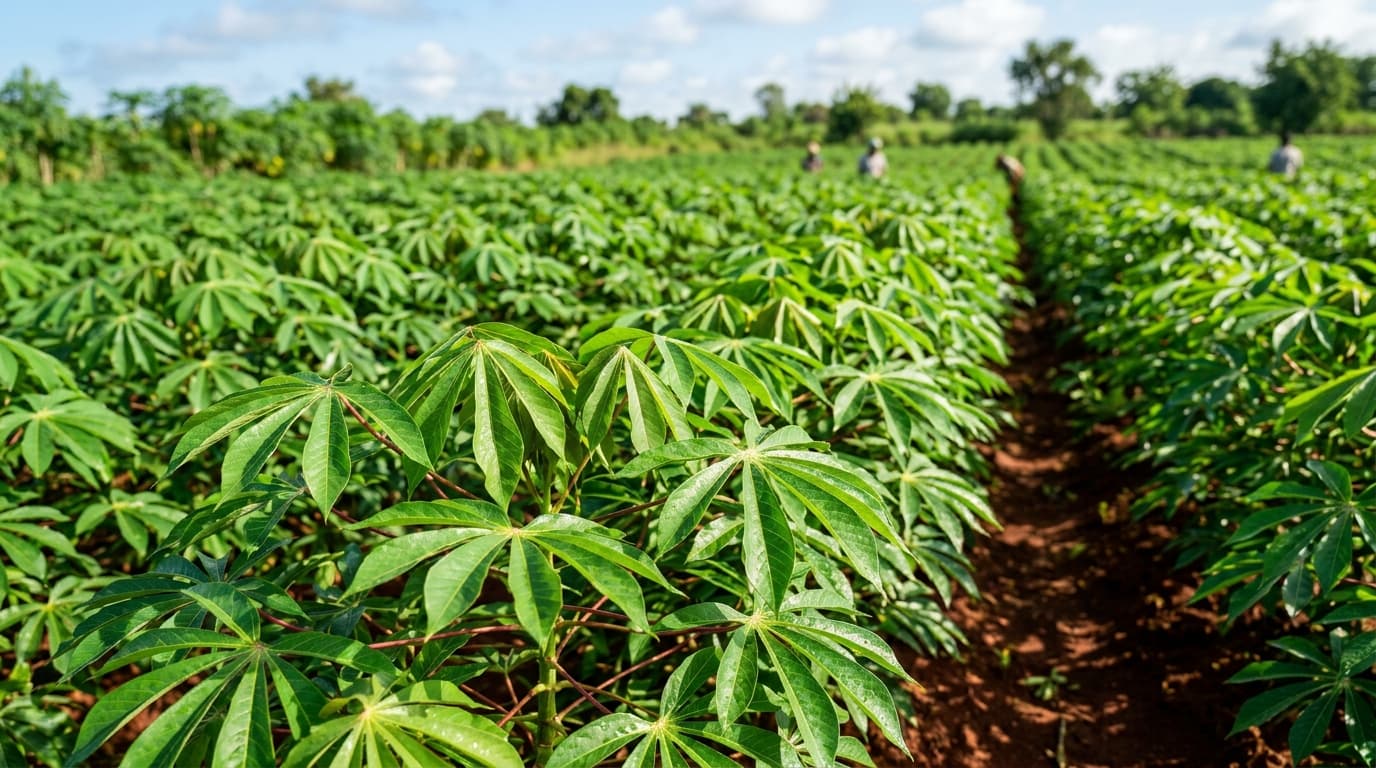
SECURING REGIONAL CASSAVA NETWORKS
Our scalable non-transgenic bioprotection is deployed directly onto active plantation canopies, delivering real-time molecular resilience without changing the core genetics of African heirloom cassava varieties.
Platform Technology
Bridging Nano-Scale Engineering and Field-Level Resilience
The Immunological Analogy
Plants possess an internal immune system, but they cannot adapt fast enough to survive aggressive viral outbreaks. Traditional crop breeding takes 7 to 10 years to develop just one single disease-resistant plant variety—a timeline that cannot help an industrial processing factory running out of raw materials today.
KaaraGen solves this by delivering a temporary, programmable biological message directly to the plant. Think of it like a sprayable or soakable vaccine: it instructs the plant's cells to naturally recognize and chop up incoming virus molecules before they can travel down to ruin the roots.
Because this delicate biological message would normally burn up under the hot tropical sun or wash away in the rain within days, we anchor it inside an eco-friendly clay nanoparticle shield called BioClay™. This specialized clay capsule acts like a microscopic slow-release system, dissolving gently over 20+ days using natural ambient moisture to keep the crop continuously protected under real field conditions.
Rapid Delivery Response
Saves years compared to traditional breeding vectors.
Natural Bio-friendly Dissolution
Leaves zero harmful synthetics or toxic residue on leaves or soil.
Product Pipeline & Roadmap
CBSD-Shield
Our commercial-tier genomic immunization solution designed explicitly to shield cassava tuber development from Cassava Brown Streak Disease root necrosis.
Value Proposition Matrix
PLATFORM ENGINE: Schematic Flow
KaaraGen Core RNAi + BioClay Matrix
CBSD-Shield
Cassava Root Rot Focus. Optimized sequence matching UCBSV isolates.
Pipeline Target
Future Agro-Venture expansion targeting regional viral threats.
The Roadmap Framework
Chronological Development & Verification Sequence
In Vitro & Wet Lab Validation
Before embarking on open field deployment, KaaraGen’s immediate operational milestone centers on rigorous bench-scale validation. This phase transitions our in silico computational sequence motifs into physical synthesis, optimizing structural encapsulation of active dsRNA triggers within the protective BioClay matrix.
Crucially, this stage introduces controlled UV stability and photolysis trials to verify that the LDH nanocrystals successfully shield the nucleic acid cargo from solar degradation, ensuring a steady 20+ day biological half-life under simulated high-intensity tropical field temperatures before any environmental exposure.
The 10-Hectare Pilot Layout
To transition this technology smoothly from verified laboratory modeling into commercial field metrics, KaaraGen’s subsequent roadmap focuses on a highly controlled 10-Hectare Pilot Deployment Block.
This deployment is specifically structured for the Northern-Eastern cassava processing corridors. By applying the dual-application method (pre-planting stake soaking followed by targeted foliar sprays during peak viral transmission windows), the pilot will establish a direct, audited baseline comparison of Starch Extraction Rates (SER) between protected outgrower plots and untreated control fields.
Proof & Current Validation
⚠️ Regulatory & Investment Disclosure
KaaraGen operates under strict principles of scientific and commercial integrity. We do not present future speculative projections as existing achievements. The ledger below represents the absolute, verifiable traction our venture holds as of today:
Computational Foundation (In Silico Validation)
We have completed the independent computational design of our target double-stranded RNA sequence motifs. These proprietary sequences are specifically optimized against local East African Cassava Brown Streak Virus (UCBSV) isolates. This foundational data architecture was built entirely on private infrastructure to ensure clear separation of digital assets.
Active Institutional Engagement
We have initiated our technology transfer protocol by engagement with the Makerere Intellectual Property Management Office (IPMO). This active process is designed to structure a clean Commercial Spin-Out License or Deed of Assignment, ensuring all future corporate commercial revenues remain completely unencumbered for outside investors.
Market Data Verification
Our target customer parameters—including the 30% to 50% weighbridge rejection rates and 60% factory capacity constraints—are drawn directly from verified economic and industrial supply data within the regional starch processing corridor.
About & Corporate Mission
The Meaning Behind the Shield
The Linguistic Architecture of KaaraGen
Immunity
In the Wolof language of West Africa, Kaarange means immunity. It represents the outcome we deliver to every crop we treat—lasting protection against viral threats like Cassava Brown Streak Virus (CBSV). It's the promise we make to farmers: your harvest will be protected.
Strength
In Swahili, the lingua franca of East Africa, Imara means strength, firmness, and resilience. It represents the quality of our technology—ruggedized, field-ready, built to survive 35°C heat, UV radiation, and tropical downpours. It's the guarantee we make: our protection doesn't break when conditions get tough.
Genomics
The Gen suffix grounds us in the biotechnology ecosystem. It signals our use of genetics, RNAi, and innovation to create next-generation solutions. It's the method we use to deliver on our promise.
Bridging laboratory nanotechnology & local industrial supply chains.
KaaraGen exists to close the gap between elite laboratory nanotechnology and the real-world industrial supply chains of East Africa. Founded by biotechnology professionals who understand both the molecular mechanics of plant viral replication and the practical bottlenecks of local factory gates, we are building an indigenous platform capable of protecting Africa's industrial future from the ground up.
"We are not here to sell chemicals. We are here to establish a dynamic, responsive genetic shield that keeps African agricultural production robust, securing industrial raw material supplies against the silent pathogen threats of today and tomorrow."
Team & Strategic Advisors
.jpg&w=3840&q=75)
Joshua Mark Mwase
Founder & Technical LeadCredential: Biotechnologist | In Silico Sequence Design & Biosecurity Engineering.
Specialized in in silico molecular design, viral replication modeling, and biopolicy frameworks. Serves as lead designer of KaaraGen's target RNA sequence motifs.

Muhammad Senabulya
Computational Biology LeadCredential: Specialist in Bioinformatics and Computational Biology.
Specialized in autonomous data pipeline architecture, sequence alignment algorithms, and RNA secondary structure predictive modeling. Serves as the core architect of KaaraGen’s in silico automation and host-crop off-target screening frameworks.
B2B Secure Portal
Access Technical Data & Pilot Specifications